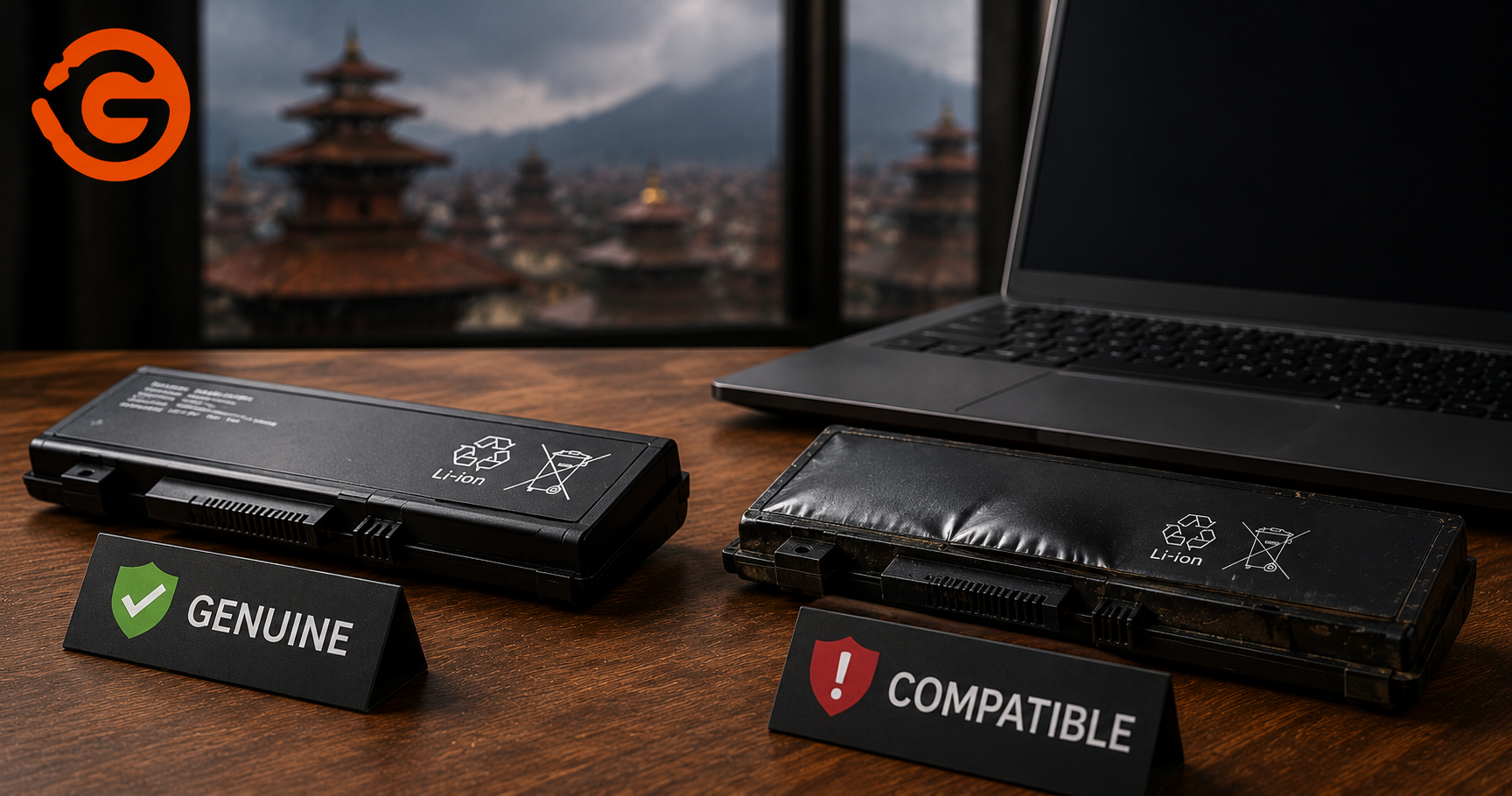
An original battery costs more. A compatible one sitting right next to it in the same shop costs noticeably less and claims the same specifications. It's a genuinely reasonable question to ask which one actually makes sense, and the honest answer isn't simply "always buy genuine" or "compatible is fine." It depends on specifics most people never get told to check.
Why Choosing the Right Laptop Battery Matters More Than Saving a Few Thousand Rupees
Price is the first thing most people compare, but it isn't the only thing that matters, and treating it as the only factor is how people end up with a battery that causes more problems than it solves. Battery quality affects real runtime, how stable charging actually is, how long the battery lasts before degrading, how much heat it generates during use, genuine compatibility with your specific laptop, the quality of its internal protection circuitry, and ultimately the overall safety of the device you're using every day.
What Is a Genuine or Original Laptop Battery?
A genuine or original battery is one sourced from, or manufactured to the exact specification of, the laptop's original manufacturer. This is worth being precise about, because marketing language in this space gets used loosely. Terms like "OEM quality," "OEM," and "100% original" appear constantly in battery listings, and not every seller using these terms is actually supplying a manufacturer-original battery. A label claiming authenticity isn't the same thing as verified authenticity, which is exactly why this distinction matters before you buy, not after.
What Is a Compatible Laptop Battery?
A compatible battery is a third-party replacement designed to work with a specific laptop model, built by a manufacturer other than the laptop's original maker. This isn't automatically a downgrade. A genuinely good compatible battery, from a manufacturer that gets the fundamentals right, can be a legitimate option when it has appropriate cell quality, proper protection circuitry, a functioning battery management system, the correct voltage, the correct connector, accurate capacity, and consistent, reliable manufacturing behind it. The word "compatible" describes a category, not a quality level, and that category includes everything from genuinely solid products to poorly made copies.
Genuine vs Compatible Laptop Batteries: What's the Difference?
It helps to think about this across three tiers rather than a simple two-way comparison, since a compatible battery from a reputable manufacturer and a compatible battery from an unknown source are genuinely different products, not variations on the same thing.
A genuine, manufacturer-sourced battery is designed specifically for the model, generally has tightly controlled cell quality, includes manufacturer-designed protection circuitry, usually reports battery status reliably to the operating system, tends to have a predictable lifespan, comes at a higher price, and typically includes a clear warranty. A quality compatible battery, from a manufacturer that takes the specification seriously, is also designed for the model, with cell quality that depends on that specific manufacturer, protection that depends on their design choices, reporting accuracy that can vary somewhat, a lifespan that's less predictable but often still reasonable, a noticeably lower price, and warranty coverage that depends entirely on the seller. A poor-quality copy, by contrast, may have inconsistent compatibility despite claiming to fit, highly variable and often unverified cell quality, protection circuitry that may be inadequate or missing entirely, unreliable or inaccurate reporting, an unpredictable and often short lifespan, a very low price, and warranty coverage that's frequently unclear or effectively nonexistent.
The core message worth taking from this comparison: cheap does not automatically mean unsafe, and expensive does not automatically mean genuine. What actually determines safety and reliability is where a specific battery falls across cell quality, protection circuitry, and manufacturing consistency, not simply which price tier or category label it's sold under.
Why Are Original Laptop Batteries More Expensive in Nepal?
Several real cost factors stack up behind the price difference: sourcing directly through the manufacturer's supply chain, the cost of the specific battery chemistry and cells used, the protection electronics built into the pack, the battery management system itself, model-specific design rather than a generic form factor, import costs specific to bringing genuine parts into Nepal, warranty backing, more limited availability compared to generic alternatives, the reputation and overhead of legitimate sellers, and the broader supply chain genuine parts travel through compared to generic, mass-produced alternatives. None of these costs are arbitrary markup, they're real inputs that a compatible battery, particularly a cheaper one, is often cutting corners on somewhere.
What Makes a Cheap Laptop Battery Risky?
It's worth being precise here rather than making a blanket claim: not every inexpensive battery is dangerous, and price alone isn't a reliable safety indicator. The actual risk comes from unknown quality, specifically batteries where cell quality, protection circuitry, real capacity, manufacturing consistency, or safety testing haven't been properly verified or controlled.
Where that unknown quality is present, the realistic risks include excessive heating during normal use, capacity loss far faster than expected, unstable or inconsistent charging behavior, physical swelling, unexpected shutdowns, battery readings that don't match actual charge level, and premature failure well before a reasonable expected lifespan.
What Is Thermal Runaway in a Lithium-Ion Battery?
Thermal runaway describes an uncontrolled increase in a battery's internal temperature that can, in more severe cases, lead to serious battery failure. This is a real phenomenon worth understanding in straightforward, factual terms rather than sensationalized ones. Quality battery cells, properly designed protection circuitry, genuine manufacturing controls, and a correctly functioning charging system are all specifically there to reduce this risk, which is exactly why each of those factors matters far more than the price tag alone.
Can a Cheap Laptop Battery Catch Fire or Explode?
Lithium-ion batteries in general can present safety risks when they're damaged, defective, improperly manufactured, charged incorrectly, or physically abused, regardless of brand or price point. This isn't unique to cheap batteries specifically, but batteries of unverified quality carry meaningfully higher risk simply because fewer of the safeguards described above can be assumed to be present and functioning correctly.
Watch for real warning signs: physical swelling, unusual heat during normal use, any smoke, an unusual smell, visible physical damage, or capacity that's degrading unusually fast without explanation. If you notice a visibly swollen or severely damaged battery, stop using it and seek professional assistance rather than continuing to use the laptop while monitoring the situation.
How to Identify a Genuine Laptop Battery Before Buying
A practical checklist worth working through: confirm the correct battery part number for your exact laptop model, verify actual compatibility rather than assuming based on connector shape, check for proper manufacturer labeling, confirm the listed specifications match what your laptop actually requires, look for serial or identification information where the seller provides it, assess overall packaging quality, consider the seller's actual reputation rather than just their claims, confirm what warranty is genuinely offered, understand the return policy before purchasing, and check for battery condition or manufacturing date information where it's available.
It's worth being direct about one thing: labels alone don't prove authenticity. A battery can carry professional-looking branding and still not be what it claims to be, which is why the other checks on this list matter alongside, not instead of, the labeling itself.
How to Check a Compatible Laptop Battery Before Buying
For a compatible battery specifically, verify the voltage matches your laptop's actual requirement, confirm the stated capacity, check the specific battery model or part number against what your laptop uses, verify the connector type matches exactly, confirm physical dimensions will actually fit your laptop's battery bay, understand the cell configuration if that information is available, double check compatibility against your exact laptop model rather than a similar one, assess the apparent quality of the protection and battery management system, and confirm what warranty, if any, the seller actually stands behind.
Battery Capacity: Does a Higher mAh or Wh Always Mean Better?
Not automatically, and this is a common point of confusion. Wh (watt-hours) and mAh (milliamp-hours) both describe energy capacity, but a higher number on either measurement only matters if the battery is also electrically and physically compatible with your specific laptop in the first place. A battery advertising a higher capacity than your original one isn't a meaningful upgrade if it doesn't match your laptop's voltage requirement or physical battery bay, and chasing the biggest number without checking actual compatibility is a common and avoidable mistake.
Why the Battery Management System (BMS) Matters
The battery management system is the electronics inside the battery pack responsible for monitoring and managing voltage, current, and temperature in real time, controlling the charging process itself, protecting individual cells from unsafe conditions, and communicating accurate battery status back to your laptop. A battery with a poorly implemented or absent BMS loses much of this real time protection and monitoring, which is precisely why BMS quality matters as much as, or arguably more than, the raw capacity number printed on the listing.
Can a Compatible Battery Damage Your Laptop?
The honest, nuanced answer: a properly designed compatible battery from a reputable manufacturer doesn't inherently pose a risk to your laptop simply by virtue of being third-party. The real concern is an incorrectly specified, defective, counterfeit, or poorly manufactured battery, regardless of whether it's labeled "compatible" or something else entirely. The category isn't the problem. Unverified quality within that category is.
Why the Correct Battery Voltage Matters
A battery that physically fits your laptop's battery bay and connector isn't automatically the right battery. Physical compatibility and electrical compatibility are two separate things, and confusing them is one of the more common and more consequential mistakes people make when buying a replacement. A battery with the wrong voltage specification can cause real problems even if it slots into place without any resistance, which is exactly why checking actual voltage specification matters as much as confirming the connector shape.
Original Battery vs Compatible Battery: Which One Should You Buy?
Choose a genuine, manufacturer battery when you specifically prioritize manufacturer-specified parts, your laptop is relatively new or genuinely valuable to you, the price difference compared to a quality compatible option is reasonable, or predictable compatibility and clear warranty coverage matter more to you than saving money.
Consider a quality compatible battery when genuine battery availability for your specific model is poor or nonexistent, your laptop is older and a lower-cost option makes more practical sense, a reputable compatible option genuinely matches the required specifications, and the seller provides meaningful, real warranty coverage rather than just a verbal assurance.
Avoid a battery entirely, regardless of genuine or compatible labeling, when the seller can't identify where the battery actually came from, the listed specifications don't clearly match your laptop's requirements, the price is suspiciously far below the realistic market range, there's no warranty or return policy offered at all, or the battery itself shows any visible swelling or physical damage before you've even installed it.
Why Buying the Cheapest Battery Can Cost More in the Long Run
The simple version of this argument: a cheap battery with poor runtime and unreliable performance often needs early replacement, meaning you end up paying for multiple batteries over the same period a single quality battery would have covered. A quality battery, by comparison, tends toward better reliability and a longer useful life, meaning fewer total purchases over the same stretch of time. This isn't a guarantee of any specific lifespan for either option, lifespan varies by usage and conditions regardless of battery quality, but the general pattern holds often enough to be worth factoring into the upfront price comparison rather than looking at sticker price alone.
How to Check Laptop Battery Health Before Replacing It
Reduced runtime alone isn't a reason to automatically buy a new battery. A proper technician check can confirm actual battery health, current full charge capacity compared to original design capacity, real charging behavior, actual battery voltage, whether the battery is reporting status accurately, and whether the adapter or charging circuit is contributing to the problem rather than the battery itself. Skipping this check and replacing the battery on assumption alone risks spending money on a part that was never actually the problem.
Battery Replacement vs Laptop Charging Circuit Repair: Which Do You Need?
This is genuinely one of the more valuable distinctions in this entire guide. A laptop that isn't charging doesn't automatically need a new battery. The actual fault could sit anywhere along the power path, the battery itself, the charger, the DC jack, the charging circuit, or the broader motherboard. Proper diagnosis traces this path specifically to identify where the real problem is, which prevents paying for a new battery when the actual fault was a charging circuit issue that a battery replacement would never have fixed.
How Much Does an Original Laptop Battery Cost in Nepal?
Rather than quoting one universal figure, which would be misleading given how much this varies, actual price depends on brand, specific model, the exact battery part number required, rated capacity, current availability, whether you're looking at genuine or compatible options, warranty terms, and import or sourcing costs specific to that part. Contact us directly with your laptop model and, if you have it, the battery part number, and we can give you an accurate price based on real current availability rather than a generic estimate.
Why Choose Guru Computer Solution for Laptop Battery Replacement in Kathmandu
Battery Health Diagnosis First We check actual battery condition before recommending replacement, rather than assuming reduced runtime automatically means a new battery is needed.
Model and Part-Number Verification We confirm the exact part number and specification required for your specific laptop before sourcing any replacement.
Genuine Battery Sourcing Where Available For models where genuine batteries are accessible, we source them directly rather than substituting a compatible option without telling you.
Quality Compatible Options Where genuine availability is limited, we offer compatible batteries selected for verified specification and build quality, not just the lowest price available.
Battery and Charging-System Testing We test the battery itself and the broader charging system together, since a "battery problem" is sometimes actually a charging circuit issue.
Professional Installation and Warranty Information Every replacement comes with clear warranty terms explained upfront, not buried in fine print.
Support for Major Laptop Brands Dell, HP, Lenovo, ASUS, Acer, MSI, and MacBook battery sourcing and replacement.
Choose Battery Safety Over the Cheapest Price
The cheapest laptop battery available isn't always the cheapest solution once you account for reliability, safety, and how long it actually lasts. A battery worth buying is compatible, properly manufactured, correctly specified for your exact laptop, and backed by a seller you can actually trust, not just the option with the lowest number on the price tag.
Before buying a replacement battery, bring your laptop in, or share the exact model and battery part number, so the correct battery can be properly identified.
Frequently Asked Questions
What Is the Difference Between a Genuine and Compatible Laptop Battery?
A genuine battery is sourced from or built to the original manufacturer's exact specification. A compatible battery is a third-party replacement designed to work with the same model, ranging in quality from genuinely solid to poorly made depending on the specific manufacturer behind it.
Is a Compatible Laptop Battery Safe?
It can be, when it comes from a reputable manufacturer with proper cell quality, protection circuitry, and correct specifications. The risk comes from unverified quality, not from the compatible category itself.
Are Original Laptop Batteries Worth the Extra Money?
Often yes, particularly for newer or higher-value laptops where predictable compatibility and warranty coverage matter. For older laptops or when a reputable compatible option is available, the extra cost may be less necessary.
How Much Does an Original Laptop Battery Cost in Nepal?
Price varies by brand, model, and battery part number. Contact Guru Computer Solution with your exact laptop model for accurate current pricing.
How Can I Tell If a Laptop Battery Is Genuine?
Check the exact part number, verify specifications against your laptop's actual requirements, assess seller reputation, and confirm warranty terms. Labeling alone isn't sufficient proof of authenticity.
Can a Fake Laptop Battery Damage My Laptop?
A battery with incorrect specifications, poor manufacturing, or inadequate protection circuitry can cause charging instability, excessive heat, or in more serious cases, safety risks. The concern is unverified quality specifically, not the compatible category as a whole.
What Is Thermal Runaway in a Laptop Battery?
An uncontrolled rise in a battery's internal temperature that can, in severe cases, lead to serious battery failure. Quality cells, proper protection circuitry, and correct charging systems all help reduce this risk.
Can a Cheap Laptop Battery Explode?
Lithium-ion batteries of any price point can present safety risks when damaged, defective, or improperly manufactured or charged. Batteries of unverified quality carry higher risk since fewer safety safeguards can be assumed present.
Does Higher mAh Mean a Better Laptop Battery?
Not automatically. A higher capacity number only matters if the battery is also correctly voltage-matched and physically compatible with your specific laptop.
What Voltage Should My Laptop Battery Have?
The exact voltage your original manufacturer specifies for your model. A battery that physically fits but has the wrong voltage is not a safe substitute despite fitting the connector.
Can I Use a Different Brand Battery in My Laptop?
Yes, provided it's genuinely compatible in voltage, capacity, connector, and physical dimensions with your specific laptop model, not just a battery that appears similar.
How Long Should a Replacement Laptop Battery Last?
This varies by battery quality, usage, and charging habits, and we avoid guaranteeing a specific lifespan, but quality batteries generally offer more predictable, longer service life than unverified low-cost alternatives.
Why Is My New Laptop Battery Draining Quickly?
This can point to a genuinely low-quality battery, an incorrect specification match, or a charging system issue unrelated to the battery itself. A proper check can identify which applies to your situation.
Does Guru Computer Solution Sell Genuine Laptop Batteries?
We source genuine batteries where available for your specific model, and offer quality compatible options where genuine availability is limited.
Do You Install Laptop Replacement Batteries?
Yes, we handle both sourcing the correct battery and professional installation.
What Laptop Brands Do You Provide Batteries For?
Dell, HP, Lenovo, ASUS, Acer, MSI, and Apple MacBook laptops.
Can You Check My Battery Before I Buy a Replacement?
Yes. We can test your current battery's actual health and diagnose whether replacement is genuinely needed before you spend on a new one.
What Should I Do If My Laptop Battery Is Swollen?
Stop using the laptop immediately and seek professional assistance. A swollen battery is a safety issue that should be addressed right away, not something to continue using while monitoring.
When Should I Bring My Laptop to Guru Computer Solution?
Whenever you're considering a battery replacement, noticing reduced runtime, experiencing charging problems, or seeing any sign of battery swelling or physical damage.