When buying a printer, most people compare the purchase price first.
An ink cartridge printer may look cheaper upfront, while an ink tank printer often costs more to buy. But the real cost of owning a printer is not the price you pay on day one.
Over several years, you also have to consider ink, maintenance, cleaning, replacement parts, printhead issues, paper-feed problems, and repairs.
So which is cheaper in the long run: an ink tank printer or a cartridge printer?
The answer depends on how much you print, how often you use the printer, and how well you maintain it.
Ink Tank vs Cartridge Printer: What's the Difference?
The biggest difference is how ink is supplied.
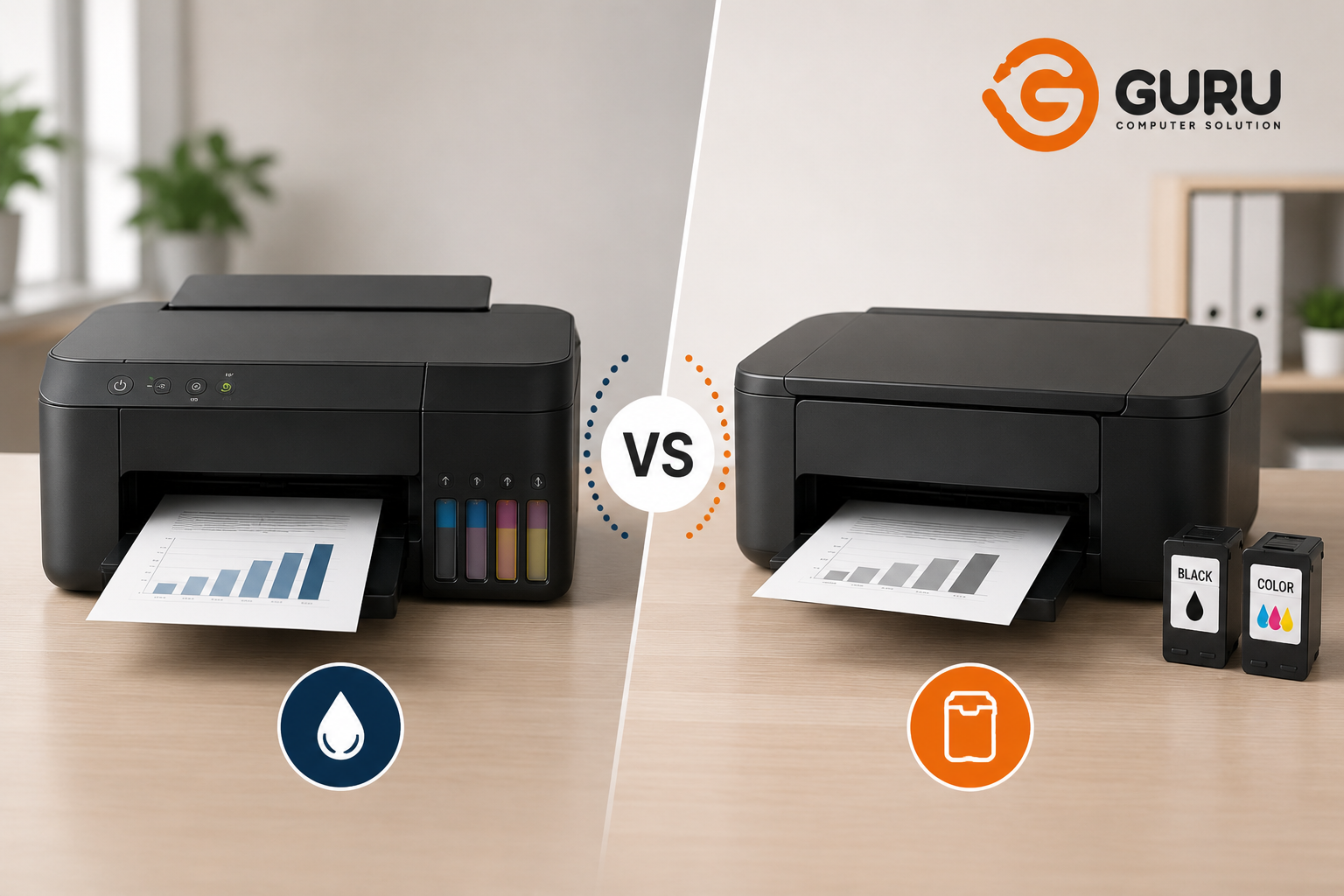
An ink tank printer uses refillable ink reservoirs that you fill with bottles.
A cartridge printer uses replaceable ink cartridges containing a relatively smaller amount of ink.
Ink tank printers are generally designed for users who print frequently, while cartridge printers can make sense for lighter or occasional printing.
But long-term ownership involves more than ink consumption.
Initial Purchase Cost
Cartridge printers are often attractive because their initial purchase price can be lower.
This makes them popular for:
- Students
- Home users
- Occasional printing
- Small offices with low print volumes
Ink tank printers typically cost more initially.
However, the higher purchase price can be offset by lower ink costs over time if you print regularly.
This is why comparing only the printer's purchase price can be misleading.
Ink Cost Over Several Years
This is where ink tank printers generally have their biggest advantage.
Instead of replacing a complete cartridge whenever the ink runs out, you refill the printer's tanks using ink bottles.
For people who print hundreds or thousands of pages, the difference can become significant.
A cartridge printer may require frequent cartridge purchases, especially when printing:
- School materials
- Business documents
- Reports
- Marketing materials
- Color graphics
- Photos
An ink tank printer can usually handle high-volume printing with much lower ink cost per page.
However, cheaper ink does not mean zero maintenance.
The Hidden Cost: Printhead Maintenance
This is one of the most important things buyers overlook.
Inkjet printers use printheads to place ink onto paper.
If the printer is left unused for long periods, ink can dry or clog the nozzles.
This can result in:
- Missing lines
- Faded colors
- Streaks
- Incorrect colors
- Poor print quality
Both ink tank and cartridge printers can experience printhead-related problems.
The difference is that an ink tank printer may hold a large amount of ink inside its system, so maintenance and cleaning need to be handled properly.
Automatic printhead cleaning can also consume ink. Canon, for example, warns that frequent unnecessary printhead cleaning can rapidly use up ink.
What Happens If You Don't Use the Printer?
This is where your printing habits become important.
If you print every few days, an inkjet printer generally gets regular ink flow through the printhead.
If you print only once every few months, dried ink and clogged nozzles can become more likely.
For extremely occasional printing, a cartridge printer may sometimes make more sense because you are not keeping a large refillable ink system filled for long periods.
However, cartridges can also dry out or become unusable if stored or used improperly.
The best printer isn't determined only by the ink system.
Usage frequency matters.
Ink Tank Printer Repair Costs
Ink tank printers have fewer recurring cartridge purchases, but they are not maintenance-free.
Potential repair issues include:
Clogged Printhead
One of the most common problems with inkjet printers.
Symptoms include:
- Missing colors
- Horizontal lines
- Blank areas
- Poor color reproduction
Depending on the severity, cleaning may solve the issue.
A severely blocked or damaged printhead may require replacement.
Ink Leakage
Improper filling, damaged ink lines, overfilling, or internal problems can result in ink leakage.
Ink inside the wrong part of the printer can create additional problems.
Ink Supply System Problems
Some tank-based printers use tubes and internal components to deliver ink to the printhead.
Air entering the system or problems with ink flow can affect print quality.
Waste Ink System
Inkjet printers use ink during cleaning cycles, and some of that ink ends up in a waste-ink system.
Eventually, the printer may require maintenance related to the waste ink system.
Cartridge Printer Repair Costs
Cartridge printers can also develop mechanical and electrical problems.
Common issues include:
- Cartridge recognition errors
- Cartridge chip problems
- Clogged printhead
- Paper-feed problems
- Carriage errors
- Ink leakage
- Sensor problems
- Power issues
One advantage is that replacing the cartridge itself can sometimes resolve a problem caused by an empty or defective cartridge.
However, a new cartridge will not repair a damaged printhead, carriage mechanism, or motherboard.
Which Printer Has More Expensive Repairs?
There isn't a universal answer.
The cost depends heavily on the printer model and the failed component.
A basic ink tank printer may be inexpensive to repair for a simple issue but expensive if a major electronic or printhead component fails.
A cartridge printer may be cheaper to purchase but can become uneconomical to repair if expensive cartridges are repeatedly required or if a major component fails.
The key point is:
Ink cost and repair cost are separate considerations.
A printer with cheap ink isn't necessarily cheap to repair.
Which Is Better for a Small Office?
For an office that prints regularly, an ink tank printer can be financially attractive because of its low running cost.
It can be particularly useful for:
- Invoices
- Reports
- Forms
- Marketing materials
- School/college documents
- Color documents
However, if the office requires extremely high-volume printing, it may be worth considering a business-class inkjet or laser printer rather than choosing a consumer ink tank printer simply because its ink is inexpensive.
Which Is Better for Home Users?
For home users, the answer depends on printing frequency.
Choose an Ink Tank Printer If:
You print regularly and want lower long-term ink costs.
It makes particular sense if your household prints a significant number of pages every month.
Choose a Cartridge Printer If:
You print occasionally and want a lower initial purchase cost.
For very light printing, paying more upfront for a tank system may not provide enough savings to justify the difference.
The Most Important Factor: How Much Do You Print?
Think about your actual usage.
If you're printing only a few pages every month, the expensive part of ownership may not be ink at all.
If you're printing hundreds of pages every month, ink consumption becomes much more important.
If you're printing thousands of pages, running costs become a major factor and a high-volume printer may be a better investment.
Don't buy a printer based on someone else's printing habits.
Buy it based on yours.
Maintenance Tips for Ink Tank Printers
To keep an ink tank printer reliable:
- Use the correct ink recommended for the printer.
- Don't mix incompatible inks.
- Keep ink tanks properly closed.
- Avoid overfilling.
- Print periodically if the manufacturer recommends regular use.
- Keep the printer away from excessive dust and moisture.
- Don't repeatedly run deep cleaning cycles without a reason.
- Follow the manufacturer's maintenance instructions.
- Address poor print quality before the problem becomes severe.
Most importantly, don't wait until the printer is completely blocked before addressing print-quality problems.
Maintenance Tips for Cartridge Printers
For cartridge-based printers:
- Use compatible cartridges designed for your exact model.
- Install cartridges correctly.
- Keep cartridge contacts clean.
- Avoid leaving the printer unused for very long periods.
- Store unused cartridges according to the manufacturer's instructions.
- Don't repeatedly remove and reinstall cartridges unnecessarily.
- Run maintenance cycles only when required.
If a cartridge isn't recognized, don't immediately assume the printer's motherboard has failed.
The cartridge, electrical contacts, chip, carriage, or firmware may be responsible.
What About Compatible or Refilled Cartridges?
This can significantly change the long-term cost calculation.
Third-party or refilled cartridges may cost considerably less than original cartridges.
However, quality varies.
Potential issues include:
- Incorrect ink
- Poor print quality
- Cartridge recognition errors
- Leakage
- Inconsistent colors
- Premature cartridge failure
The cheapest cartridge isn't always the cheapest option if it causes repeated cleaning, poor output, or printer problems.
Ink Tank vs Cartridge: Which One Lasts Longer?
The physical lifespan of the printer isn't determined simply by whether it uses tanks or cartridges.
A well-maintained printer can last for years.
What matters more is:
- Print volume
- Maintenance
- Print frequency
- Environment
- Paper quality
- Ink quality
- Mechanical wear
- Repair history
A poorly maintained ink tank printer can fail earlier than a well-maintained cartridge printer.
Likewise, a heavily used cartridge printer may develop mechanical wear long before a lightly used ink tank printer.
What About Repairability?
This is another important consideration when buying a printer.
Before purchasing, look beyond the specifications and check whether:
- Replacement printheads are available
- Rollers are replaceable
- Service support exists locally
- Genuine parts are available
- The printer has a good repair ecosystem
- Technicians can diagnose the model
A printer may be inexpensive to purchase but difficult to repair if important parts are unavailable.
For office users, local service availability can be just as important as the printer's advertised ink cost.
The Real Long-Term Cost of a Printer
Don't calculate ownership cost using only:
Printer Price + Ink
A more realistic calculation includes:
Printer + Ink + Paper + Maintenance + Replacement Parts + Repairs + Downtime
For an occasional home user, the difference may be relatively small.
For a business printing thousands of pages, the difference can become substantial.
That's why businesses should evaluate total cost of ownership rather than simply choosing the cheapest printer on the shelf.
So, Which Is Cheaper in the Long Run?
For regular, medium-to-high volume printing, an ink tank printer will usually have the advantage in ongoing ink costs.
For occasional printing, a cartridge printer can make sense because of its lower initial investment.
But maintenance can change the equation.
An ink tank printer still needs proper printhead care, correct ink, periodic use, and maintenance.
A cartridge printer can also become expensive if cartridges are frequently replaced or if poor-quality cartridges cause additional problems.
The best choice depends on how you actually use your printer.