When a laptop keyboard needs replacing — from liquid damage, worn-out keys, or a few dead switches — most people jump straight to "full keyboard replacement" without checking two things first: whether they actually need the whole keyboard replaced at all, and if they do, whether OEM or generic is the right call for their specific situation. Both decisions change the cost and outcome significantly.
Step Zero: Do You Actually Need a Full Replacement?
Before comparing OEM vs. generic, it's worth ruling out a cheaper, faster fix. If the problem is isolated to one or two specific keys — not a wider pattern across the keyboard — a single-key replacement is usually the better option.A single-key repair typically costs a fraction of a full keyboard swap and takes only a few minutes, compared to a full replacement that can cost far more and take a laptop out of use for days.
Single-key replacement makes sense when: one or two keys are physically broken, missing, or the key mechanism (scissor clip, rubber dome) has failed, but the rest of the keyboard types normally.
Full keyboard replacement is needed when: multiple keys across different areas have stopped working (often a sign of ribbon cable or connector failure, not individual key damage), there's been liquid damage, or the keyboard deck itself is physically cracked.
Once you've confirmed a full replacement is actually necessary, here's how OEM and generic compare.
What "OEM" and "Generic" Actually Mean
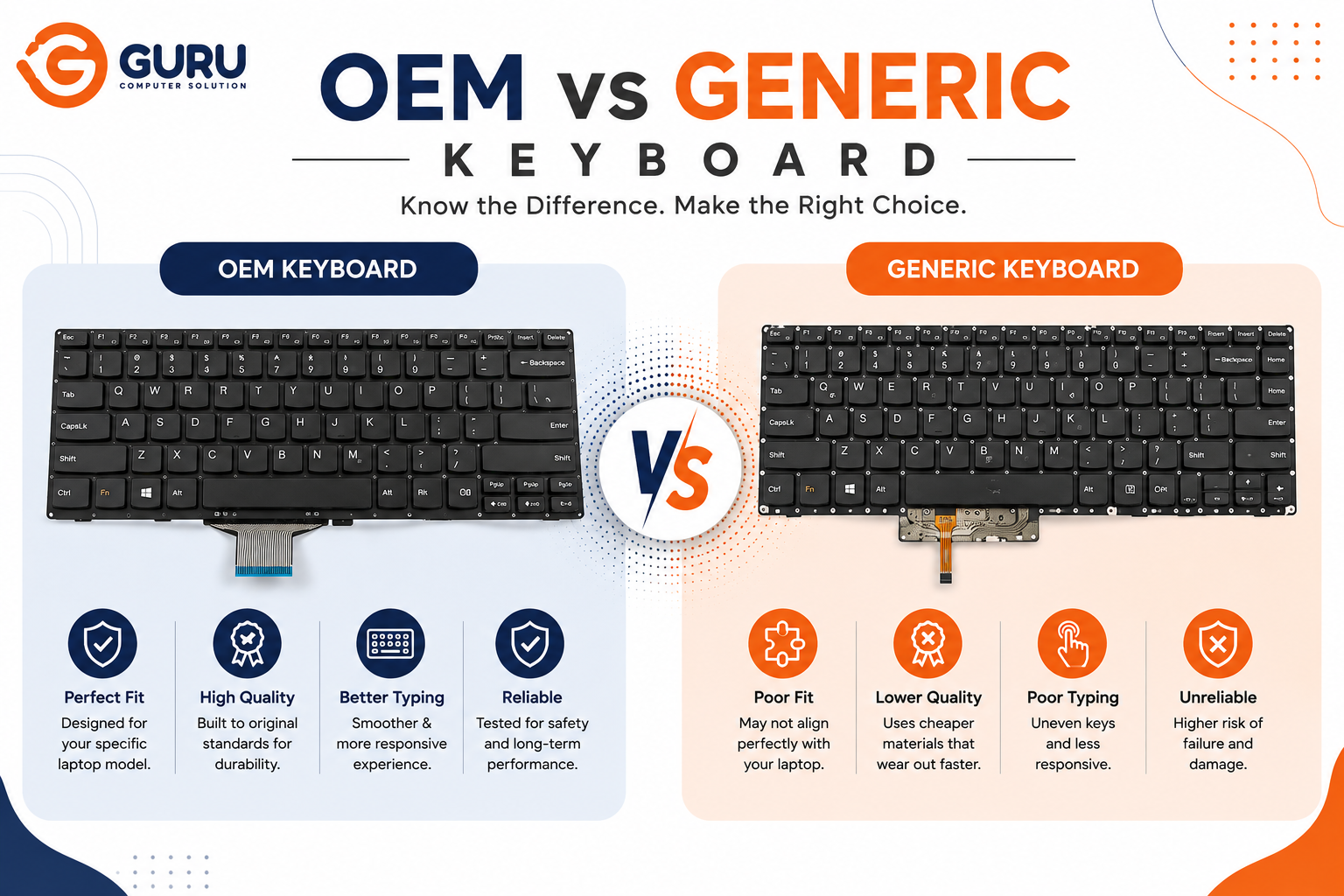
OEM (Original Equipment Manufacturer) keyboards are made to the exact specification the laptop manufacturer originally used.These are typically more expensive but offer the highest quality and the most reliable, exact fit for your specific laptop model.
Generic/aftermarket keyboards are third-party manufactured replacements designed to physically fit the same laptop model, without the manufacturer's original tooling. They're generally more affordable, and many reputable third-party manufacturers now produce keyboards that are genuinely compatible and reliable across a wide range of laptop models — though quality still varies significantly by supplier.
OEM Keyboards: Pros and Cons
Pros:
- Guaranteed fit — connector type, mounting points, and dimensions match exactly
- Consistent key feel and travel distance matching the original typing experience
- Identical key layout, feel, and backlighting if the original had it
- Often comes with manufacturer warranty coverage
- Generally more durable long-term, built to the same standard as the original component
Cons:
- Higher cost — genuine manufacturer parts commonly cost noticeably more than third-party equivalents for the same laptop model
- Longer sourcing time, especially for older or less common models
- Not always available for discontinued models
Generic Keyboards: Pros and Cons
Pros:
- Significantly lower cost — for many models, a well-reviewed third-party option can deliver close to OEM-level performance at roughly half the price
- Wider availability, including for older models where OEM stock has dried up
- Often faster to source since more suppliers stock them
Cons:
- Compatibility isn't always 100% guaranteed, and typing feel, key travel, or backlighting quality can differ from the original
- Backlighting is the most common weak point — genuine OEM units typically use the original LED driver chip, enabling smooth dimming and proper low-power behavior, while aftermarket boards can flicker or lack proper software control
- Build quality varies significantly between suppliers — this is the single biggest source of complaints
- Warranty coverage is inconsistent and often shorter than OEM
The Quality Gap Has Narrowed — But It's Not Universal
It's worth updating a common assumption: cheap generic keyboards used to mean a noticeably worse typing experience across the board. That's less true today for well-sourced parts, though it still depends heavily on the specific supplier. Reviewers analyzing successful installations found that exact model-number matching was consistently cited as the top factor in a successful, well-fitting replacement — meaning the biggest quality risk with generic keyboards usually isn't the keyboard itself, it's buying a mismatched or wrong-SKU part.
This is also true for OEM parts, just less commonly a problem: compatibility with proprietary designs isn't just about matching the brand—it depends on matching the exact model number, since backlight circuitry and physical layout can vary even within the same product line.
The practical takeaway: the OEM vs. generic decision matters less than getting the exact model-specific part right, regardless of which category you choose. A generic keyboard matched precisely to your model number will consistently outperform a "close enough" OEM-branded part sourced for a similar but not identical model.
Where the Difference Actually Matters Most
Typing feel: noticeable immediately for anyone sensitive to keyboard feel — key travel, spacing, and resistance rarely match OEM exactly on lower-quality generic parts.
Backlit keyboards: this is where generic parts most commonly disappoint — inconsistent lighting, missing zones, flickering, or backlighting that doesn't function despite the keyboard otherwise working normally.
Older or discontinued models: generic is often the only realistic option, since OEM parts may no longer be manufactured or stocked anywhere.
Business/fleet devices: consistency across multiple devices matters more here — mixing OEM and generic replacements across a fleet creates a noticeably inconsistent typing experience between machines.
What We Actually Recommend
Choose OEM when:
- The laptop is relatively current and OEM parts are readily available
- Typing feel and consistency matter to the user
- The keyboard has backlighting that needs to function correctly, especially with per-zone or color-sync lighting
- Budget allows for the price difference
Choose generic when:
- The laptop model is older and OEM parts are scarce, expensive, or discontinued
- Budget is the primary constraint and minor typing feel differences are an acceptable tradeoff
- The keyboard doesn't have backlighting to worry about matching
- You've confirmed the supplier sources exact model-number matches, not "compatible with similar models"
Questions to Ask Before Choosing
- Is OEM actually available for this specific model, and what's the real price difference?
- If choosing generic, does the listing specify your exact model/SKU, or just a general "compatible with" range?
- Does the replacement support backlighting (if your original had it), and does the supplier confirm this specifically, not just generically?
- What's the warranty coverage on the part, regardless of which type you choose?
- Has the technician installed this specific keyboard model or supplier's part before, and can they speak to its actual quality?
Why Choose Guru Computer Solution
Single-Key and Full Replacement Options We assess whether your issue actually needs a full keyboard swap or just a targeted key repair, rather than defaulting to the more expensive option.
Both OEM and Verified Generic Parts We stock and source both, matched to your exact model number, and give you an honest comparison specific to your laptop rather than defaulting to whichever is more profitable to sell.
Verified Compatibility Before Installation We confirm connector type, backlight support, and exact model fit before committing to a part, avoiding installation surprises.
Warranty on All Replacements Whether OEM or generic, our keyboard replacements come with warranty coverage for your peace of mind.
Conclusion
OEM keyboards offer guaranteed fit, consistent feel, and better long-term durability, at a higher cost. Generic keyboards offer significant savings and broader availability, with more variability depending on the supplier. But the factor that matters most, more than the OEM-vs-generic label itself, is exact model-number matching — a precisely matched generic part will outperform a loosely matched OEM one. Start by confirming whether you even need a full keyboard replacement, then choose based on your model's availability, your budget, and how much backlighting and typing feel matter to you.
If your laptop keyboard needs replacing and you're unsure which option makes sense, contact Guru Computer Solution for an honest recommendation matched to your exact model.