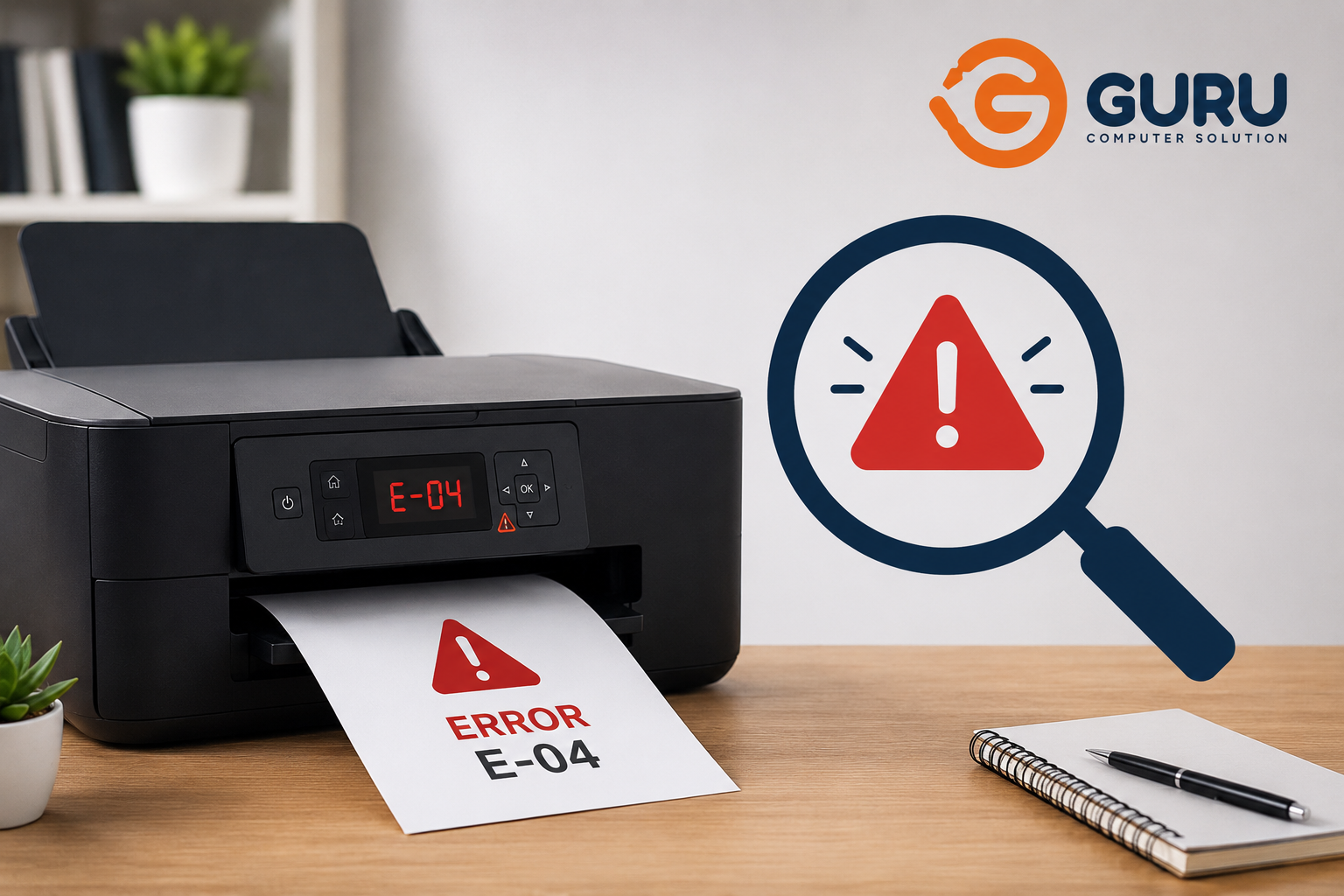
Seeing an error code on your printer can be frustrating, especially when the message looks like a random combination of numbers and letters.
The good news is that most printer error codes are not designed to confuse you. They are simply the printer's way of telling you that something needs attention.
You don't need to be a printer technician to understand the basics.
In this guide, we'll explain what printer error codes mean, what you can safely check yourself, and when it's better to get professional help.
What Is a Printer Error Code?
A printer error code is a message generated by the printer when it detects a problem.
The problem could be something simple, such as:
- No paper
- Paper jam
- Low ink or toner
- Open printer door
- Cartridge not recognized
- Wi-Fi connection problem
It could also indicate a more serious issue involving the printer's hardware.
The important thing is not to focus only on the code itself. Look at the error message, printer behavior, and what happened immediately before the error appeared.
Why Do Printers Show Error Codes?
Modern printers contain sensors and electronic components that constantly monitor different functions.
For example, the printer can detect whether:
- Paper is available
- A cartridge is installed correctly
- The printhead is moving
- The paper path is clear
- The printer is connected to a network
- The internal temperature is normal
- A particular component is responding correctly
When something falls outside the expected condition, the printer may display an error code.
Think of it as the printer saying:
“Something isn't working as expected. Here's a clue about where to look.”
Common Printer Errors You May Encounter
Paper Jam Errors
Paper jam errors are among the most common printer problems.
Even when you cannot see a sheet of paper stuck inside, a small torn piece can trigger the sensor.
Turn off the printer if the manufacturer's instructions recommend doing so, open the appropriate access areas, and carefully remove visible paper.
Avoid pulling paper aggressively because torn pieces can remain inside the paper path.
Ink or Toner Errors
Your printer may display messages such as:
- Ink cartridge not recognized
- Replace cartridge
- Low ink
- Toner low
- Cartridge error
These don't always mean the cartridge is physically empty.
The problem can sometimes be caused by incorrect installation, dirty contacts, an incompatible cartridge, or a cartridge chip problem.
Remove and reinstall the cartridge carefully. If the error remains, check the manufacturer's instructions for your exact model.
Printhead Errors
If the printer reports a printhead problem, the issue may involve the printhead itself, its electrical contacts, or the printer's ink system.
Basic cleaning or reseating may help on some models, but repeated cleaning cycles should be avoided when they aren't solving the problem.
Offline or Network Errors
If the printer shows as offline, the printer itself may be perfectly healthy.
The problem could be the Wi-Fi connection, router, IP address, computer settings, or printer driver.
If the printer was recently connected to a new router or the Wi-Fi password was changed, reconnecting the printer to the network may solve the issue.
General Hardware Errors
Messages such as “Printer Error,” “Service Required,” or similar hardware-related codes deserve more attention.
These can indicate problems with:
- Sensors
- Motors
- Printhead
- Paper-feed mechanism
- Power system
- Mainboard
- Internal electronics
If the same error returns immediately after restarting the printer, don't keep repeating the same reset procedure.
Should You Restart the Printer?
Sometimes, yes.
A simple restart can clear a temporary software or communication problem.
Turn the printer off normally, wait for it to shut down completely, and turn it back on.
However, restarting won't repair a damaged component.
If the same error appears every time the printer starts, you need to investigate the actual cause.
Don't Search Only by the Error Code
One of the most useful things you can do is search for the exact printer model together with the error code.
For example, instead of searching:
“Printer error 5100”
search:
“Canon PIXMA [exact model] error 5100”
Different printer models can use different codes and troubleshooting procedures.
The manufacturer's support page or user manual should be your first source for model-specific instructions.
When Should You Stop Troubleshooting?
Basic troubleshooting is fine when the problem involves paper, cartridges, connections, or simple configuration.
But be careful when the printer:
- Makes unusual mechanical noises
- Smells burnt
- Shows repeated hardware errors
- Doesn't power on
- Has liquid damage
- Keeps restarting
- Has a suspected motherboard problem
- Shows an error immediately after a component was replaced
At that point, repeatedly resetting or disassembling the printer can make the problem worse.
A professional diagnosis can determine whether the issue is related to the printer's software, configuration, mechanical system, or electronics.
Printer Error Codes Are Clues, Not Conclusions
The most important thing to remember is that an error code is usually a starting point for diagnosis, not a complete explanation of what's wrong.
A paper-jam code doesn't always mean there's an obvious sheet of paper stuck inside. A cartridge error doesn't always mean the cartridge is empty. And a hardware error doesn't automatically mean the entire printer needs to be replaced.
Read the message carefully, identify your exact printer model, follow the manufacturer's recommended troubleshooting steps, and avoid unnecessary resets or part replacements.
And if the same error keeps coming back after basic troubleshooting, it's usually time to stop guessing and have the printer properly diagnosed.